Private Hear Each month, in association with the Radio Advertising Bureau, Campaign magazine presents two industry experts reviewing the best and worst radio ad campaigns
Hugh Todd, Creative Director, Leo Burnett Radio. How hard can it be? Get a junior team to bash out a comedy sketch. Record with some jobbing voiceover in Soho. Sorted. And another little turd pollutes the airwaves of Britain, destined never to reach the shores of Cannes. Radio is meant to be a soft category. But, for us Brits, it seems to have got extremely hard lately. Two shortlists last year, down from 12 the year before and 21 the year before that. Maybe we need to up our game.
If TV and digital posters can talk to my phone, why can’t we get a radio ad to talk to my device? How about buying the whole ad break, creating your own radio show within a radio show? Like "Miller time"... on radio. Maybe don’t even do ads. Do what DraftFCB in New Zealand did for Secret Diary Of A Call Girl:
It’s one of the most creative media. Painting pictures in the mind is still one of the toughest challenges a creative can get. Yet it feels so neglected these days. Let’s see if there’s any love for it this week.
Public Health England’s Stoptober. The Pub Landlord in a classic announcement ad, urging people to stop smoking in October. It’s well-written, funny and upbeat. It won’t trouble the juries, but it’s simple and, if it stops people dying, it’s a good thing.
Homepride. A voiceover tells how Homepride sauces won’t let us down in homage to the Rick Astley song Never Gonna Give You Up. Hmm. A fairly thin premise. If you’re going to use Rick Astley, I’d say use him in a kitsch, kooky way. Rather than in a rhyming-his-songs-to-a-strategy way.
Transport for London. A great example of radio sounding effortless and simple. Admittedly, road death is slightly more compelling than cooking sauces (and cigarette death?), but all involved have done well here. It draws you in – getting you to think about the innocent things you’ve regretted – and then jolts you with the sickening sound (and regret) of pulling out at a junction.
BelVita. This ad features a guy trying to sing like Ghostpoet. I’m not feeling well-disposed to this already. He’s singing about "morning wins" that have been sent in by members of the public. "Morning wins"? Say it out loud. No, me neither. I wonder whether the creatives wrote that line. Or were forced into it. I really hope it was the latter. He gives it his best, but this may not bear as much repeat listening as our Rick.
The Start-Up Loans Company. A bloke bemoans his life commuting to work. He thinks he’s turning into his dad. He needs a loan. That’s it. Maybe he should do the lottery like the grandad in the next ad.
Camelot. A real phone call. Or, at least, sounds real. Old fella being told he has won £6 million. Love it. Super-simple. Really fresh. Avoiding the clichéd thought of what you would do with the winnings. Instead, merely capturing the moment when people are told. Maybe this is part of a campaign? That would be great. Well done to all involved. There is hope.
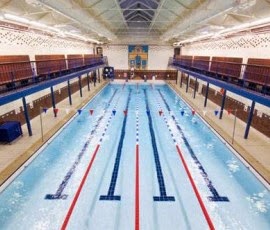
I suppose it was on a Tuesday lunchtime standing butt naked in the
showers at Chelsea Sports Centre that I found God. Or rather he found me.
In the form of ‘Marky Sharky’, an intense, bald-headed swimming
instructor who, also butt naked, was inviting me to his church this coming
Sunday to ‘let the joy of God into my
life’. It was an awkward moment as you can imagine, especially as I was
letting the joy of suds drip off my ball-sack. God wasn’t really on my mind.
I gave him my politest smile – he was a big bloke – before informing
him I already had my church of choice. But thanks anyway.
And so my introduction to the peculiar people of public swimming
baths began.
Over the past 18 years, due to a persistent back problem, I’ve needed
to swim every few days. During this time I’ve frequented public baths all over
London and inevitably met ‘the regulars’.
It never fails to amaze me how these slightly downtrodden
swimming pools are actually a hot bed of men wanting a chat. A heart to heart.
In the buff. Maybe it's something Freudian? Being stripped back bare to our
most naked that brings it on. Or something more basic? Like a pub. Without
clothes.
At first I avoided Mark and the others – Pete with the gammy eye,
Andy with the excess skin - I saw them as an additional irritant to my aching spine. Not
to mention the Thai receptionist whose dodgy English and even dodgier til
merely added more stress.
But now looking back, I kind of miss them and their idiosyncrasies.
You see I’ve crossed over. From public to corporate. A new job has
propelled me to more salubrious lunchtime dips. Gone are Marky Sharky and the
gang. The 120 screaming school kids (Tuesdays and Thursdays). And geriatric
Wednesdays.
In comes the corporate experience with mahogany paneled showers, tiptronic
Celsius temperature control at your fingertips. And beautiful bodies lapping up and down to
'Now that's what I call corporate ambient pool music 47'.
At first I was excited. Lush infinity pool; immaculately clean
changing rooms, a silent drying machine and endless smiles from pretty girls at
reception.
I even joined in the digital survey touch pad at reception, giving
said pretty girls a '10'.
The complementary white towels (large and small) were the
clinchers I’d 'arrived'.
What’s not to like? There was nothing not to like. It’s just so…corporate. Nothing memorable or
remotely interesting. So clean and pristine it'd had the soul power-sprayed out
of it.
After a few weeks I realised I hadn’t spoken to a single soul. In fact to
date (15 months) I have only had visual communication with people -
those reception smiles & nods again. After the honeymoon period I longed
for my grumpy Thai receptionist and the wrong change.
Chelsea Sports Centre and the real world drifted back into my
thoughts. Granted the odd turd and plaster floated back too. But all things
considered, screaming kids, poo and random naked men were all part of the charm
of the place.
I miss Mark and his questions on whether I’d met God at the weekend.
I loved it when he would latch onto some new unsuspecting non-believer and I
could hear him going thru his spiel in the showers. More poignant was the day
he started telling me of his mail order Ukrainian bride. It ended after 8
weeks, but didn’t stop him practicing his Russian on me.
I miss Pete too. And his Thom Yorke eye. At first I thought he was staring me out. Giving me the hard
look in the middle lane. Was I going too slow? Had I disrespected his towel?
But one day he cornered me and there was no escape. And he confessed he swam
cos he too had a bad back. Phew. A chance to have a regular blokey moaning session about our spines.
Next there was Andy and his excess skin. His appearance – which
couldn’t fail to catch the eye – huge rolls of excess
skin folded over on themself hanging on top of his trunks – was as a result of
extreme weight loss, from 26 stone to 13. The weight went. But the skin didn’t.
Poor bugger. He’s looked into surgery but ended up living with it. And having
to explain to whoever was interested. And once we’d got over that we were free
to talk about other stuff. Such as the towel thief who’d nabbed mine just that
day meaning I had to dry myself on the hairdryer. Embarrassing. But another
great conversation piece for the gang. Which I was firmly part of.
Never thought I'd say it but I miss those guys. I feel a sense of
loss no complimentary towels or power shower can replace.
Maybe I should take Marky Sharky’s advice and turn to God.
Why we're loving: Hugh Todd, Darren Keff and Phillip Meyler, creatives, Leo Burnett
WHAT THEY DID
In their new film for the charity Business in the Community, Todd, Keff and Meyler subverted the notion of the “skip ad” button to make people think twice before writing off ex-offenders.
Tell us about ‘second chance’. Even people who consider themselves open-minded often have a twinge of concern when they hear that someone has been in prison. Ex-offenders are often considered "a bit dodgy", with their CV binned before they even get to an interview. Or, if they don’t mention their past on the application form, they then have to deal with rejection at the interview. The brief was to try to change this behaviour. Or, at the very least, challenge it.
What is the aim of the campaign? We wanted people – especially HR professionals – to confront their prejudice against ex-offenders; to try to make them feel what it’s like for an ex-offender to be rejected in the interview room. Where did you get the idea for the film? Using and subverting the "skip ad" function gave us the opportunity to fulfil the brief. It felt like a really good fit with the prejudice ex-offenders experience. We’d not seen an idea like this before and were curious how to pull it off.
It was a bit of a head-fuck at times. What initially seemed a very simple thought had many layers – writing and shooting four versions in total to make the idea work for the three potential "skips".
As part of our research, we interviewed inmates in Wandsworth Prison to understand the job application process from their perspective. We also interviewed ex-offenders who are now trying to get work. Once we had a master script, we then started to write the shorter, more urgent ones.
In the film, our ex-offender needed to demonstrate a range of emotions. From growing confidence in the un-skipped version to becoming more and more defeated in the skipped ones.
So the casting was crucial. He needed to be able to adapt his performance quickly, but with subtlety and control. If he went too aggressive, we’d lose the audience; too soft, and he appears a victim. The key was empathy.
We were pleased that Blink’s Dougal Wilson agreed to shoot the film. Not only is Dougal brilliant with casting and performance, but he also got involved at the script stage to help develop the idea.
"Live TV ads from Afghanistan? Really? Like that live Honda Ad. Except with tanks. And guns. In a war zone..... So nothing like the Honda ad. I love it.' 6 months ago Jon & Anita - a creative team at JWT London - came into our office with an idea for the Territorial Army. It was to be JWT's first piece of work for the Army since winning the account last year. With such a fantastic body of work from Saatchi's hanging heavy in our minds and a need to recruit extra numbers for the TA, the pressure was on. Several teams had already had a go at the brief with no luck, so we were getting a little twitchy It was a tricky one. From research we knew one of the main things that put applicants off were ads that featured actors pretending to be soldiers. The thing they really liked was seeing action - real action - not blokes with make up on, running around Salisbury Plain. Brutally honest TV docs such as 'The TA and the Taliban' and 'Young Soldiers' that show what it is really like to be a modern soldier is what they want.
So I imagine all of this was whizzing round Jon & Anita's heads as they came up with what is one of the most audacious ideas I've ever heard: Live ads from a war zone (Afghanistan), broadcast directly into the nation's front rooms on a Saturday night, showing the TA serving alongside the Regular Army. We loved it for its sheer ambition. In a moment it could change people's perceptions of the TA as a bunch of weekend warriors, to showing them standing alongside the Reg Army firing the same guns, driving the same trucks, wearing the same body armour, harbouring the same fears. 'So a bit like that live Honda' ad I said. 'But with guns. And tanks. In Afghanistan. 8 times a weekend. For 2 weekends on the trot. With a dedicated youtube channel. And simultaneous 'Live' events happening around the UK' J&A replied. 'So nothing like the Honda ad. But I love it.' The next question: How? Many meetings followed. Mediacom...C4, ITN, Sky. 'How do we technically pull this off? Who is going to actually go there and shoot this stuff? And most importantly how do we do it without anyone getting killed.' Everyone said it was going to be hard. A real challenge. Never been done before. Bespoke approach needed. But no one said 'No'. Least of all our brilliant and brave client. ITN took up the media challenge, with the indomitable Chris Church and his team at the helm. So after flying out a satellite truck, some very big aerials and a lot of cable, we were ready.
Next up was the 'war room' at ITN, variously occupied over two weekends by the JWT Army team, Clearcast, our client. And by the end of the second weekend, a lot of empty pizza boxes.
We took live feeds from Afghan. Within seconds these were edited to 48 secs, topped and tailed with intro and outro idents forming a complete 60 second ad. This then needed instant approval from client and Clearcast. If either party rejected the ad (bad language, guns pointing at camera etc), a back up ad was always ready to roll. It was a little jumpy at times, esp when someone pointed a gun at camera and swore, but overall it ran fairly smoothly, thanks in most part to Chris and the boys at ITN.
Jon & Anita remarked one of the toughest things was being forced to watch ITV's entire weekend schedule. However by the end I think they were a little partial to people falling over on ice...
However the real star of the show wasn't dancing on ice or anywhere near Greys Inn road. But he was 3,500 miles away in Afghan holding the camera, barking orders at the TA: Nick Murphy. Toby Clifton our smart, funny, chain-smoking TV producer had taken up the production challenge, ringing and researching and talking and eventually unearthing Nick, who became our director and general head of all stuff over there in Afghan, ably assisted by Derek Tedder and Kevin Capon from the MOD. Thankfully no-one got killed, we got two successful weekends of 15 live broadcasts - a first for UK TV - and I hear the phones have been ringing at the TA centres ever since. Many people made this project happen, but if there was one who really needs the biggest thanks it's Nick. I'll let him take over the reins from here with an interview first published by shots.net 2 weeks ago.
People often use the word ‘brave’ when talking about advertising. “It was a brave campaign.” “They’re a brave client.” But the risks in this industry pale in comparison to those taken on a daily basis by the soldiers on operations in Afghanistan.
In a ground breaking campaign by JWT London for the Territorial Army (TA), the Army Recruiting Group and Capita plc, a company that provides recruiting services, last weekend launched TA Live.
Live commercials were filmed in Afghanistan and screened almost simultaneously on ITV in the UK, showing TA soldiers working alongside the regular Army. Another series of films will air this weekend so we caught up with director Nick Murphy to find out what it’s like to live in a warzone, what the challenges of shooting live TVCs are, and how it feels to work for a client that carries more than one gun.
How did you get involved with the project and what did you think when you first heard about it?
Nick Hirschkorn at Feel films, which represent my advertising work, were approached about the project and there seemed to be a natural match between what the guys at JWT were trying to achieve and the various areas of my career. I grew up in documentaries before I moved into drama and features and the creatives, Jonathan Budds and Anita Davis, didn't want the reality of the spots to be overwhelmed by advertising artifice or conceits. They were after little, high impact windows on the lives of these TA soldiers that told the audience: "Look, this what these guys are doing right now." The TA needs to recruit thousands, so the live ads needed to make the audience take notice and radically shift their perceptions of what the TA is.
What’s living in a war zone like?
Well if you like neat lines and hand washing then I suggest you move to one. It's an OCD paradise. That takes some getting used to. But certainly the fact that you're in a conflict situation, having to work creatively in a conflict situation, is the most immediate challenge. Let's be clear, what the guys and girls out here do is immeasurably more difficult and important, so you have to keep your trap shut with the complaints. But when you're trying to work out how you'll capture a moment or get round a problem and an Apache helicopter thunders overhead, you do get a bit thrown. The place runs with a ruthless efficiency. They all want to help, subject to their primary tasks, but they don't want rambling media twaddle. They just want to know where they need to get what and when. No b***shit. Soho could do with a dose of that.
What kind of challenges does the location add to the project?
All the departments that the people we are following might come into contact with are spread about the place. So progress on access and consent in advance of the live nights was slow. The chain of command is rigid so a meeting to work out what the lads on the ground might be doing when we go live means nothing until you have gone back and cleared it with the correct Commander. I never felt we weren't going to get there but navigating round such a new environment was problematic. It's a far cry from booking Black Island, hiring a crew and pitching up with a storyboard under your arm. Then again, they almost never get mortar attacks at Black Island studios so they can afford to run things differently.
What have been the most difficult problems to overcome?
Planning logistics were a nightmare. This is a war zone and it's a long way away so you can't just drive the satellite truck up to the gates and ask to come in. Toby Clifton at JWT and Steve Ryder who owns the truck and is out here with me, worked through unimaginable paperwork to get the truck onto a RAF C17 and fly it in from the UK.
Then there is the technical challenge of getting our feed from our truck into ITV network at precisely the right time with the correct approvals of Clear Cast and Capita. Chris Church and the team at ITN did all that and it's like making sausages, I honestly don't care to know how they did it.
But from my point of view, the toughest challenge was not making these things into adverts. At least not in the traditional sense of the word. Initially the guys we began shooting with - to get them used to us - would keep spouting the party line. It took quite a while, skills I'd learned in docs, to get them to understand that none of us wanted that. Me, JWT, the client Capita, none of us wanted shiny boys and girls telling us how marvellous it was. We just wanted to glimpse what a TA soldier experiences when he or she is deployed. We didn't want people to learn about TA life, we wanted them to feel something about TA life and be able, through the live immediacy of it, to compare it to their own lives.
Some people would say that shooting live ads is suicide, but in the literally, potentially life-or-death situation you’re working in, it must be a huge amount of pressure. How have you coped?
Up and down. You get moments when you know that something is happening that you can't catch because of the hours - we are 4.5 hours ahead of UK so the primetime slots were pretty late for us. There is also the very real risk that 'operational imperatives' - and that is literally all I am allowed to call them - will interrupt what we are doing, even if we are on air at the time. That's a risk the team were willing to take.
We knew that situations might arise that would pull us off air or eviscerate our best laid plans without notice. But you can't go into this sort of venture without understanding and accepting that. The impact of these ads stems from the fact that it is happening right now in a part of the world where bad things can happen and risks are very real. Yes, that makes the whole project infinitely more challenging and risky than, say, a series of ads from a beach in Ibiza. But that is why they work. And honouring that quality in them has been my job out here.
How supportive of the project has the army been and were there any major concerns from them?
I don't doubt that winning support for this unbelievably ambitious and bold project was tougher than other campaigns and it's a credit to the ambition and determination of Capita and JWT that this ever got off the ground. But the support the Army has given us here has been superb. Cautious but superb. I've been working closely with Derek Tedder from the Land Forces News team, who knows the territory from within but given the Army has other very real concerns to juggle, I'm still amazed we gained the access we have.
How much attention is paid to not revealing classified/sensitive information?
It's been the main concern for the Army while we've been here. For them and of course for me, it is paramount that we don't inadvertently leak information that could put any of our forces or operations at risk. But I'm often unable to judge that. Take an Apache; it doesn't cost £45m without being crammed with stuff the army would rather keep secret.
Have there been any close calls in terms of almost showing something that’s off limits?
I was shooting in a certain helicopter the other day, not live but for some background material, and a huge box right in front of me was "off limits". It was almost impossible to keep out of frame.
There isn’t a great deal happening in one or two of the ads. Was it tempting to try to manufacture something interesting?
No. It became clear that in some of our slots they were just going to be hanging out.
They ended up playing cards. It was a massive slot too, big audience. But I just wanted to let it run. As it turned out, just when we went live, a Chinook helicopter passed a few hundred feet above them. Nobody looked up. They just went on playing cards and chatting like it was the most ordinary thing in the world. It ended up being the oddest and one of my favourite spots so far.
What have been your personal highlights of the experience?
The most memorable moment wasn't a good one. We were outside at one of the locations we might have ended up at that coming weekend when over the Tannoy came the words; "Op Minimise. Op Minimise". They make this call when one of our soldiers has been killed or injured and it bans anyone from making any outward communications until the family in question has been informed. After a few hours it was lifted and it turned out to be a treatable injury but for those moments, those hours, across the camp there was this feeling in the air and to a new boy like me it was so very real and genuinely upsetting. These guys out here are doing the real thing. They do it and sometimes suffer horrendous consequences.
What’s your next project and do you feel like any other job will be a breeze after this?
As a producer mate of mine used to say years ago, "Just whip the clapper boards off it'll fall
FULL CREDITS
TA Live Credits List
Project name: TA LIVE
Overall Campaign:
Client and Job Title: Zoe Boustead, Marketing Director, Army Recruiting Group
Creative agency: JWT London
Executive Creative Director: Russell Ramsey
Creative Directors: Hugh Todd & Adam Scholes
Art Director/Creative Director: Anita Davis
Copy Writer/Creative Director: Jonathan Budds
Business Director in Charge: Pete Womersley
Business Director: Michael Abbott
Planning Director: Lee McEwan
Account Director: Emily Medhurst
Account Manager: Georgina King
Media Planning Agency: Mediacom
Media Planners: Louise Goodman and Matt Weller
Media Buying Agency: M4C
TV:
JWT Integrated Production Director/Producer: Toby Clifton
Live Broadcast & Post Production: ITN Productions
ITN Executive Producer: Derek Dyson
ITN Producer: Chris Church
Director: Nick Murphy
Line Producer: Derek Tedder
Cameraman/DP: Kevin Capon
Satellite Engineer: Steve Ryder
Media Buyer: Kevin West
Promo Ads & Title Sequences:
Director / Lead Motion Graphics / Sound Design: James Keane
Additional Graphics: Lizzy Rowlatt
Digital Experience & Social Media:
Executive Digital Creative: Ricardo Figueira
Account Directors: Neil Brice and Emily Medhurst
Account Managers: John DeGraft Johnson, Georgina King and Siobhan Filmore
Art Director: Lewis Bish
Copywriter: Chris Chance
Digital Project Manager: Charlie Marshall
Designer: Jamie Green
Developers: Ben Garraud and Mickael Coelho
Planners: Kimberly Douglas and Malky Brown
eCRM:
Account Director: Patrick Dent
Copywriter: Ewan Macmillan
Account Managers: Georgina King and Siobhan Filmore
Experiential:
Head of Experiential: Jonathan Terry
Experiential Producers: David Naylor and Morten Josefsen